
Conversations with Trees: Audio Theater for Climate Education
Expand the thread below by clicking on the heading
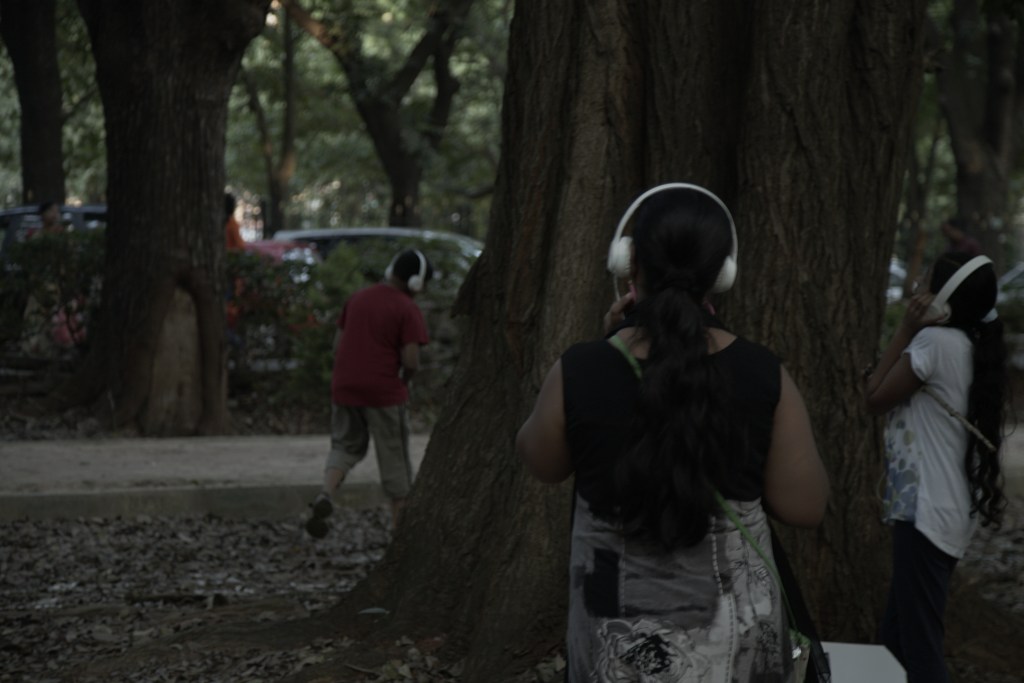
Conversations with Trees invites your school to join a pioneering environmental education initiative that combines audio theater, citizen science, and participatory storytelling to help students understand climate change through the trees in their own neighborhoods.
Over 14 months (February 2026 – April 2027), students, teachers, and community members will:
- Observe seasonal changes in local trees using SeasonWatch phenology protocols
- Create compelling audio narratives featuring student voices, street workers, and elders
- Produce immersive audio theater pieces accessible via geo-spatial app
- Build lasting relationships with urban trees and environmental stewardship capacity
This is not traditional environmental education. Students become co-creators of knowledge, transforming scientific observations into emotionally engaging stories that connect climate science to lived experience.
We seek four schools across Bengaluru representing diverse contexts:
- Urban (central Bengaluru)
- Peri-urban (emerging neighborhoods)
- Semi-rural (city outskirts)
- Mixed-income communities
Within each school, we’re looking for 2-3 champion teachers who are:
- Curious about experiential, place-based learning
- Open to co-designing curriculum rather than following prescribed plans
- Excited about integrating art, science, and community knowledge
- Willing to learn alongside students
- Committed to environmental education that centers student voice
You don’t need to be an environmental expert. You need to be willing to explore, observe, and create together.
Time Commitment
- Teachers: 4-6 hours per month for 14 months
- Monthly 4-hour Saturday workshops (one per month, 10 AM – 2 PM)
- Monthly 2-hour coordination meetings with project team
- Students: 20-30 students per school
- Monthly 4-hour Saturday workshops (February 2026 – January 2027)
- Optional: Brief tree observations between workshops
- Integration of tree observation into regular classroom time (flexible)
Space & Access
- Access to school grounds or nearby park with trees for observation
- Classroom or outdoor space for 4-hour monthly workshops
- Support for hosting one community listening event (October 2026)
Administrative Support
- MoA signing by school principal/administrator
- Parent consent for student participation and audio recordings
- Communication support (sharing project info with families)
- Flexibility for Saturday workshop scheduling
Full Support
- Expert facilitation: Ecologists, botanists, audio theater practitioners, experiential educators
- All materials: Phenology observation cards, worksheets, art supplies, recording equipment
- Training: Teachers receive comprehensive training in phenology observation, experiential education, audio production
- Volunteer support: 2-3 trained facilitators per workshop to support student engagement
- Professional production: Audio editing, app development, platform hosting
- Recognition: School featured in final audio pieces, digital platform, publications, media coverage
Curriculum Integration Support
- Alignment with national curriculum standards (science, environmental studies, language, art)
- Resources for integrating tree observation into regular lessons
- Monthly teacher support meetings to troubleshoot and refine approach
- Flexibility to adapt based on your school’s unique context
Community Engagement
- Opportunities to involve parents, street workers, nursery staff, elders as knowledge contributors
- Community listening events celebrating student work
- Enhanced school reputation as environmental education leader
BENEFITS FOR YOUR SCHOOL
For Students:
- Hands-on scientific observation skills (phenology monitoring)
- Creative expression through storytelling and voice acting
- Emotional connection to local environment and trees
- Understanding of climate change grounded in observable reality
- Confidence in scientific communication and community engagement
- Sense of agency in environmental stewardship
For Teachers:
- Professional development in experiential, place-based pedagogy
- Co-authorship of innovative curriculum
- Networking with environmental educators across Bengaluru
- Potential for conference presentations and publications
- Support for trying new teaching approaches with full facilitation backup
For School:
- Recognition as environmental education innovator
- Featured in project media, publications, and digital platform
- Lasting community asset (audio pieces accessible indefinitely)
- Enhanced parent and community engagement
- Contribution to climate science through SeasonWatch citizen science network
| Phase | Period | Key Activities |
| Phase 1: Setup | Feb–Apr 2026 | Teacher recruitment, curriculum co-design retreat, volunteer training |
| Phase 2: Monsoon | May–Aug 2026 | Monthly workshops observing monsoon-related tree changes, audio recording |
| Phase 3: Post-Monsoon | Sep–Nov 2026 | Continued observation of fruiting/seed dispersal, first audio pieces completed, community listening events |
| Phase 4: Completion | Dec 2026–Feb 2027 | Final workshops, culminating celebration, platform launch |
| Documentation | March-May 2027 | Final evaluation, case study publication, sustainability planning |
This is an inter-institutional collaboration bringing together:
- Srishti Manipal Institute (MAHE) – Lead institution; technology and research
- Upstream Ecology Foundation – Principal Investigator Janet Orlene; experiential education and community engagement
- SeasonWatch (Nature Conservation Foundation) – Citizen science phenology monitoring; botanical expertise
- Transdisciplinary University (TDU) – Field botanist Arun Kumar; species identification and ecological consultation
- Your school joins a network of expert ecologists, botanists, audio theater practitioners, and educators committed to transformative environmental education.
We will select schools based on:
- Diversity of contexts – We aim for representation across urban/peri-urban/semi-rural and socioeconomic diversity
- Teacher enthusiasm and openness – Willingness to co-design and experiment
- Access to trees – School grounds or nearby parks with observable tree diversity
- Administrative support – Principal/administrator commitment to flexibility and partnership
- Student population – Ability to engage 20-30 students (ages 9-15 preferred, flexible)
HOW TO EXPRESS INTEREST
Please complete this Expression of Interest form. We will review submissions and schedule follow-up conversations with shortlisted schools in late March 2026.
 Conversation with Trees