
Click the headers below to expand
How do we build meaningful climate literacy rooted in lived experience? How do communities become active agents of environmental stewardship? How can education honor scientific rigor and cultural knowledge equally?
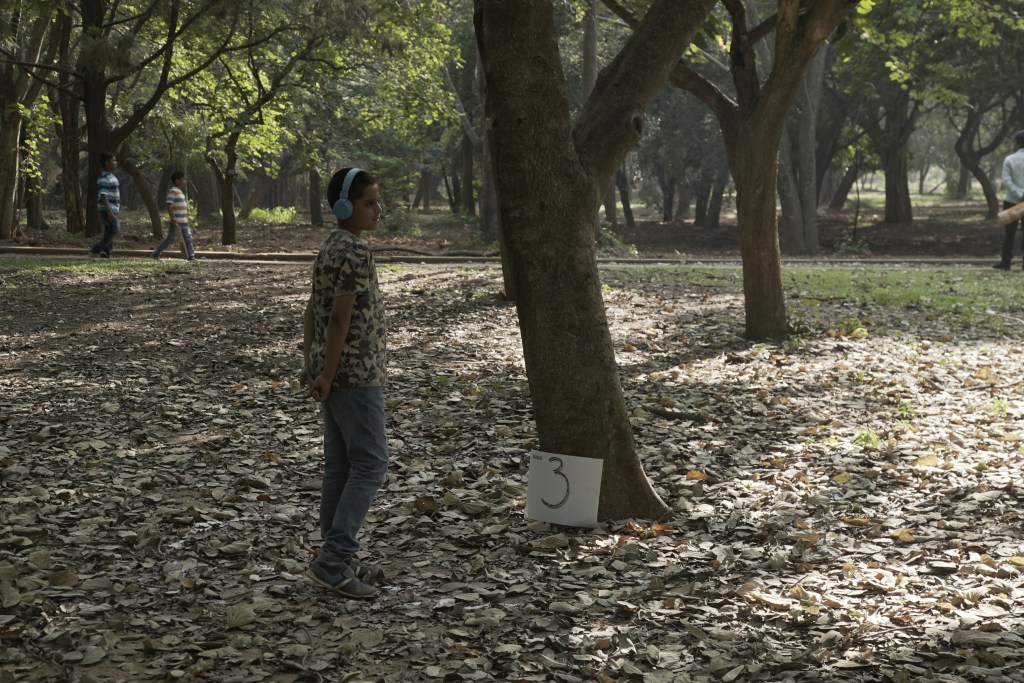
Conversations with Trees is more than an environmental education project. It’s an invitation to reimagine how students learn about climate change not as distant crisis, but as observable reality in the trees they pass every day.
It’s an invitation to position students as knowledge creators, not just recipients.
It’s an invitation to center community voices children, teachers, elders, parents alongside scientific expertise.
It’s an invitation to create something beautiful and meaningful: audio stories that will live in your neighborhood long after the project ends, inviting listeners to fall in love with the trees that make our city livable.
Expression of Interest for Schools to Join in
Over 14 months, the project engages students, teachers, school staff, parents, and neighborhood residents across four schools in Bengaluru to co-create immersive audio theater pieces that reveal the ecological and cultural significance of urban trees. Through scientific observation and creative practice, participants transform lived ecological experience into emotionally resonant storytelling that builds climate literacy, fosters connection, and motivates collective climate action.
Using phenology-based observation through SeasonWatch protocols, participants learn to notice seasonal rhythms, variability, and change in their immediate environments.. SeasonWatch protocols are used as a scaffold for repeated observation, documentation, and return, supporting ecological attentiveness rather than short-term data analysis.
Phenological observation is paired with experiential theater and participatory research methodologies that translate data and lived experience into narrative, strengthening care, agency, and commitment to continued environmental stewardship.
By integrating citizen science, creative expression, and community knowledge, Conversations with Trees demonstrates a replicable model for place-based environmental education in urban India. Key outcomes include four professionally produced audio theater pieces, a trained cohort of citizen scientists participating in phenology-based observation practices, and a geo-spatial digital platform that serves as a lasting community resource.
At its core, the project responds to urgent questions:
How do we build meaningful climate literacy rooted in lived experience?
How do communities become active agents of environmental stewardship?
How can education honor scientific rigor and cultural knowledge equally?
Grounded in Bengaluru’s specific ecology and centered on voices across age groups and social contexts, Conversations with Trees creates conditions for sustained environmental engagement beyond the grant period. The final audio theater pieces, hosted on a geo-spatial platform, invite residents to listen closely to the trees in their neighborhoods and to recognize themselves as participants in long-term urban ecological care.
Urban trees are silent heroes in our fight against climate crisis. Research demonstrates that mature trees can reduce ambient air temperatures by up to 8°C through shade and evapotranspiration, intercept significant volumes of stormwater, and sequester atmospheric carbon. Together, these functions make trees essential to the livability and resilience of cities like Bengaluru, where rising heat and environmental stress are increasingly part of everyday life.Beyond these visible roles, trees also host complex and largely unseen ecological processes.
Who would have thought that the bark of mature trees harbours trillions of microbes that consume potent greenhouse gases like methane, hydrogen, and carbon monoxide? This surprising “barkosphere” may sequester millions of tonnes of climate-active gases, revealing an overlooked dimension of urban trees’ climate-mitigating power. Yet their stories remain largely absent from mainstream environmental discourse and educational curricula. Trees are often treated as background scenery or technical assets, rather than as living beings embedded in social, cultural, and ecological relationships.
In Bengaluru, a city experiencing rapid urbanization, rising temperatures, and altered precipitation patterns, communities rarely see themselves reflected in environmental planning processes. Traditional environmental education often privileges global studies and datasets, frequently derived from Western contexts, rather than engaging with local ecosystems and lived ecological knowledge. As a result, local communities are positioned as consumers of knowledge rather than contributors to its creation and stewardship.
This creates a critical gap. Young people learn about climate change largely through abstract examples and distant case studies, disconnected from the trees, streets, and seasonal rhythms of their immediate neighborhoods.
Audio theater offers a uniquely powerful pedagogical medium. It reaches across literacy levels, age groups, and learning styles, relying not on visual dominance but on listening. Stories move people in ways facts alone cannot, because they engage emotion, memory, and meaning alongside information. Deep listening creates an intimate relationship between listener and subject, allowing trees, places, and experiences to be encountered rather than merely explained.
Geo-spatial audio extends this intimacy into lived space. When stories are embedded in neighborhoods, climate change shifts from a distant abstraction to an immediate, place-based reality. Listeners do not consume a narrative from afar; they encounter it while standing near the tree, street, or landscape being described. This proximity strengthens connection, responsibility, and care.
Critically, audio theater creates space for voices often excluded from formal environmental education. Street workers, elders, caregivers, and residents from mixed-income communities carry rich ecological knowledge rooted in daily interaction with place, yet their insights rarely enter curricula or planning processes. Audio, as a low-barrier and non-extractive medium, allows these voices to be heard without translation into academic language, preserving nuance, emotion, and lived authority.
Storytelling matters because it is how humans make sense of complexity, uncertainty, and change. Climate change is not only a scientific problem but an imaginative one: it requires people to envision futures, recognize interdependence, and locate themselves within ecological systems. Audio theater activates the human imagination, creating narrative possibilities that make climate action feel personal, relational, and achievable.
By combining storytelling with listening, and imagination with place, audio theater becomes a bridge between knowledge and action.
This project innovates at the intersection of three fields, each strengthening the others:
- Citizen science (SeasonWatch) empowers communities to contribute to phenology-based observation while building environmental literacy through direct observation of trees and seasonal change in their immediate surroundings.
- Experiential education and theater use embodied and creative methodologies, including storytelling, image theater, character development, and soundscaping, to deepen understanding and generate emotional investment in learning.
- Participatory Action Research brings together students, educators, local organizations, and community members as co-creators and knowledge holders. Research questions, methods, and interpretations emerge collaboratively, shifting power away from extractive models and centering lived experience, pedagogical insight, and local expertise.
Together, this convergence creates novelty: a model in which scientific observation becomes the foundation for creative expression, and creative expression, in turn, strengthens commitment to scientific understanding and environmental stewardship.
Conversations with Trees builds on an established foundation of practice, including audio installations in Cubbon Park (2017), and integration into SMI/MAHE courses in 2024–25. This proposal scales and sustains what was previously episodic, evolving it into a systemic, participatory model for environmental education in urban India
 Conversation with Trees